
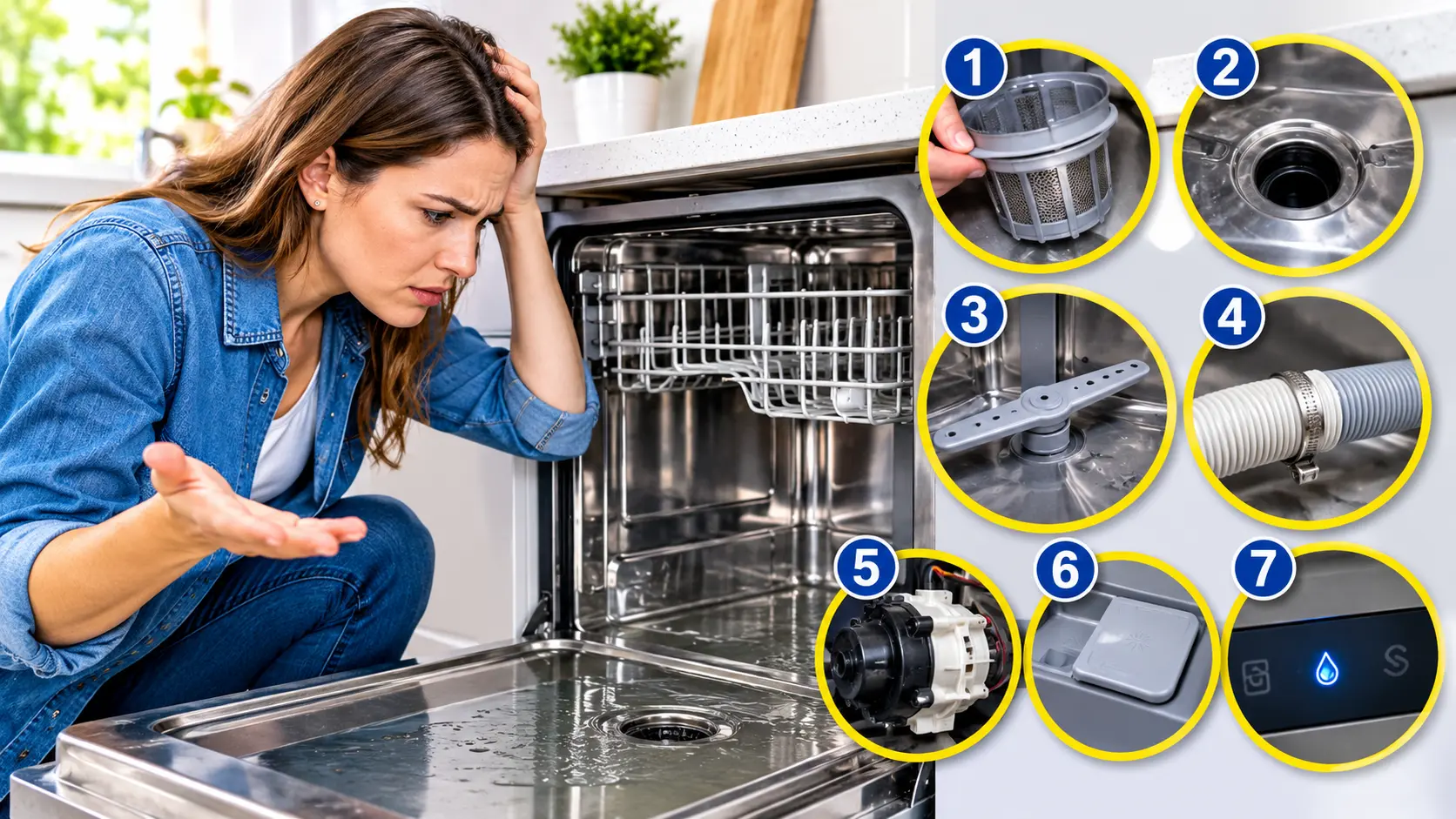
You open the door after a full cycle and find a pool of dirty water—your dishwasher not draining but no clog anywhere in sight. Frustrating, right?
When you’re dealing with a dishwasher not draining but no clog, the problem is often something small. It could be a bent hose, a stuck valve, or a part you can’t see. Most of these fixes are easy and cost little. This guide walks you through each one in plain English.
Why Your Dishwasher Has Standing Water Even Without a Clog
A dishwasher drains in a simple way. A pump pushes dirty water through a hose. The hose leads to your garbage disposal or sink drain. Along the way, there may be a filter, a check valve, and an air gap or high loop.
If any one of these parts fails, water stays in the tub. That’s why a dishwasher with standing water doesn’t always mean a clog. It can be a worn part, a bad hose position, or a stuck valve.
Dishwasher Not Draining After Cycle? Do This First
Switch off the power to the dishwasher from the fuse box and also turn off the water supply. It is recommended to switch off both the power and the water when working on the hoses and electrics.
Try resetting the dishwasher by pressing the start button for 5 seconds. If this does not work then continue through this list. Place some cloths and a small tray underneath to prevent water leaking.
Dishwasher Drain Troubleshooting: 7 Things to Check
1. Run the Garbage Disposal
Check in your dishwasher. Ensure that there is running water in the disposal. If the knockout plug has been installed in the inlet of the disposal (new disposals will have it fitted) and has not been removed by anyone, water will not be able to exit. The manufacturer says water sitting around the door could be due to clogging in the knockout plug in the disposal.
2. Clean the Filter (Even If It Looks Fine)
Clogged filters are a common problem. The filter may not be completely blocked. If there are two filters (large and small) attached together, remove the bottom drawer, turn the filter and give it a good wash in hot water. A gentle brush can be used to remove stubborn deposits. One manufacturer recommends that the filters should be cleaned every month.
3. Check the Drain Hose for Kinks
The drain hose is a bendy plastic tube. If it’s pinched behind the dishwasher or under the sink, water can’t pass. Gently pull the dishwasher forward and look along the whole hose. Straighten any bends, or replace the hose if it’s cracked or stiff.
4. Look at the High Loop or Air Gap
Many homes use a high loop. The hose rises high under the counter before going down to the drain, which stops dirty sink water from flowing back. Others use an air gap, a small cylinder on the sink or counter. Pop off the air gap cap and clear any gunk inside.
5. Test the Check Valve
The check valve keeps dirty water from flowing back into the tub. If it sticks shut, water stays put. The valve and ball often sit under the filters. Some models use a flap or ball instead. Make sure it moves freely and isn’t coated in grease.
6. Inspect the Sump
The sump is the small basin at the bottom where water collects before the pump moves it. Remove the filter screens and any sump cover, then check for debris, because buildup there can stop draining. Broken glass, toothpicks, and bottle labels hide here often.
7. Check the Drain Pump
If everything else is working correctly, the issue may be with the pump. If the pump is faulty you may get water pooling, whirring noises, or interruption in the cycle. If the pump is making a whirring noise but not pumping the water out, then this indicates that the impeller is blocked. Try removing any small debris that may be in the impeller. If the motor itself is faulty, simply replace it.
Did You Recently Remodel Your Kitchen?
If you installed a new dishwasher or sink, check the setup. Improperly installed drain hoses are a common cause after remodels, and some hoses have a built-in check valve that can be put in backward. Look at the hose direction and routing.
When to Call a Pro
Call a technician if:
- You’ve done all seven checks and water still sits in the tub.
- The pump motor hums loudly or doesn’t run at all.
- The hose is cracked or you see leaks.
- You’re uncomfortable moving the machine or working with electrical parts.
A professional can test the pump and wiring safely, and a quick repair often costs less than a new dishwasher.
Simple Habits to Prevent Drain Problems
- Scrape big food bits off plates, but skip the full pre-rinse.
- Clean the filter every month.
- Run hot water at the sink before starting a cycle, since this helps break down grease.
- Run the disposal before each load.
- Don’t use too much detergent, because extra suds can cause trouble.
FAQs
Why is my dishwasher not draining but there’s no clog?
The cause is often a bent hose, a stuck check valve, a blocked disposal knockout, or a weak drain pump. Start with the easy checks first.
Why is there standing water at the bottom of my dishwasher after a cycle?
A little water near the filter can be normal. A lot of water usually means a partial block, a hose issue, or a pump problem.
Can a dirty filter cause a dishwasher to stop draining even if it looks clean?
Yes. A thin layer of grease or fine debris can slow water flow. A clogged filter is one of the most common causes of drain trouble.
How do I know if my drain pump is bad?
Listen for humming with no water movement, or look for stopped cycles with water left behind. If cleaning the filter and hose doesn’t help, the pump is likely the issue.
Is it safe to run my dishwasher with standing water?
It’s best not to. Standing water can smell bad and grow bacteria. Remove it with a cup and sponge, then find the cause.
Final Thoughts
When your dishwasher won’t drain but there’s no clog, don’t panic. Work through the list from easiest to hardest: disposal, filter, hose, air gap, check valve, sump, and pump. Most people solve it before reaching the end.
Helpful Resources
- iFixit: Dishwasher Not Draining
- Bob Vila: What to Do When Your Dishwasher Is Not Draining
- Whirlpool: How to Fix a Clogged Dishwasher
- HGTV: Why Is My Dishwasher Not Draining?