
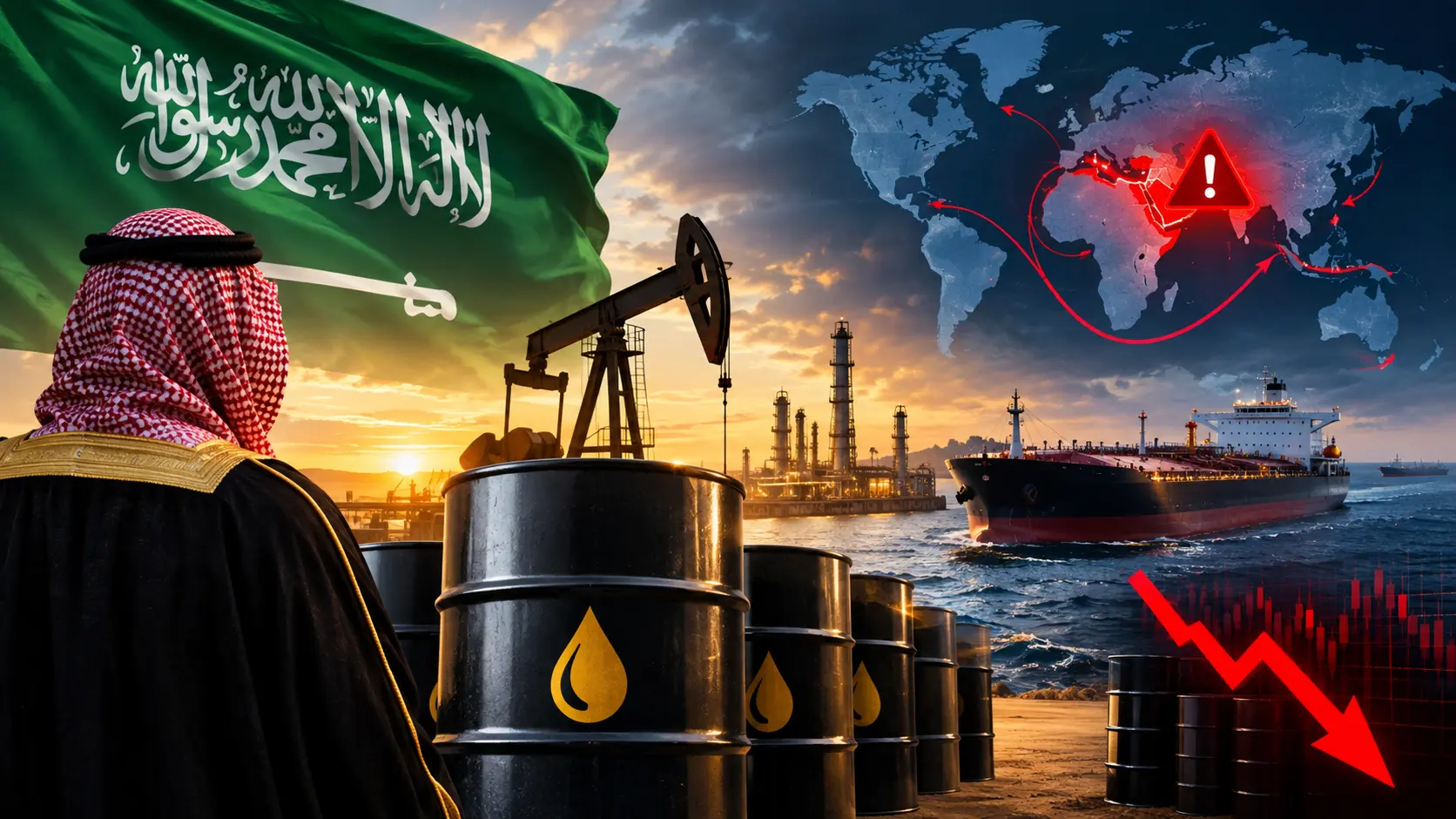
The Saudi Arabia Oil Crisis 2026 has sparked global concerns over energy security and skyrocketing fuel costs. As tension mounts in the Middle East following recent pipeline shutdowns and maritime disruptions, energy markets are preparing for widespread impact on global oil supplies.
Quick Answer
Saudi Arabia’s East-West oil pipeline was shut down on Friday, 11 September 2026, after a drone strike launched from Iraq. This pipeline normally transports crude from the country’s eastern oil fields to the Red Sea, allowing Saudi Arabia to bypass the narrow Strait of Hormuz. In addition, Houthi forces have attacked Saudi’s Jazan province and tightened their grip on the Bab el-Mandeb Strait, while separate attacks have targeted ships in the Strait of Hormuz. These factors altogether have the potential to disrupt to close to 4% of global oil supply and have caused Brent crude to jump past $107 a barrel.
What’s Actually Happening in the Saudi Arabia Oil Crisis 2026?
Here’s the short version: A drone strike that took place over the weekend of 11-13 September 2026 forced Saudi Arabia to close its East-West pipeline, a key conduit for bypassing the Strait of Hormuz through overland transport to Red Sea export terminals. Saudi authorities have been relatively quiet on the ground, offering few details about the extent of the damage or an expected reopening of the pipeline, sending shivers down the spine of energy traders.
Meanwhile, Saudi state media has weighed in with images of damaged housing and a mosque in southern Jazan province, attributed to a Houthi attack. Pakistani Prime Minister has already called Saudi Crown Prince to express condemnation of the attacks, suggesting the gravity of the situation.
The energy traders reckon that Saudi Arabia could deplete its exports within days if the pipeline remains closed, severely impacting the throughput of crude oil to ships and refineries.
Why Does One Pipeline Matter So Much?
Think of the East-West pipeline as Saudi’s back door, a way to get rid of oil besides the heavily used (and potentially dangerous) Strait of Hormuz, a narrow strip of water between Iran and Oman. This pipeline allows Saudi to keep an alternate source of export in case something were to happen to the strait. With this pipeline, oil can be sent over the Red Sea instead of being sent through the Hormuz Strait.
Without this pipeline, more sales will go towards the already risky Hormuz Strait.
How Are the Houthi and Iranian Attacks Making This Worse?
It’s not just one pipeline:
- Yemen’s Houthi forces reportedly took control of the island of Perim on Friday, tightening their hold on the Bab el-Mandeb Strait, a narrow chokepoint that has carried an estimated 4–5% of global oil supply in recent months.
- A vessel in the Strait of Hormuz was struck by a projectile over the weekend, catching fire and forcing the crew to evacuate, according to the UK Maritime Trade Operations agency (UKMTO).
- Iran says a separate strike hit one of its own commercial vessels, killing one crew member and wounding four others.
Three flashpoints at once — a damaged pipeline, a contested strait to the south, and rising danger to the east — is an unusual amount of pressure on global oil routes in a single week.
What Does This Mean for Oil Prices?
Prices have already moved. Brent crude, the global benchmark, rose more than 2.7% to around $107.51 a barrel, while US WTI crude climbed to roughly $102.32 a barrel. Both briefly jumped over 3% at Monday’s market open before settling slightly.
| Before the attacks | After the attacks |
| Saudi exports flowed through both the pipeline and Hormuz | Exports now depend more heavily on Hormuz |
| Brent crude trading well below $100 a barrel | Brent crude above $107 a barrel |
| Bab el-Mandeb seen as a manageable shipping risk | Houthis reportedly control a key point on the strait |
| Spare capacity available to absorb shocks | Analysts warn of little room left to absorb further disruption |
For households, this matters because oil prices feed straight into petrol, heating costs, and anything shipped or trucked. When supply risk rises this fast, it tends to show up at the pump within days, not months.
What Could Happen Next?
Much will depend on how quickly Saudi Arabia can repair the pipeline and whether attacks on the line persist. Prices could well fall fairly quickly if the line is opened before the end of this week; if it isn’t, further attacks – especially on Hormuz or Bab el-Mandeb – could see the market run out of spare capacity to absorb any further disruption.
FAQ: Saudi Arabia Oil Supply Risk
Q1: Why is Saudi Arabia’s oil supply at risk right now?
A drone strike shut down Saudi Arabia’s East-West pipeline on 11 September 2026, and separate Houthi and Iranian-linked attacks have hit Saudi territory and ships near the Strait of Hormuz, threatening close to 4% of global oil supply.
Q2: What is the East-West pipeline, and why does it matter?
It’s the pipeline that carries Saudi crude from eastern oil fields to Red Sea export terminals, letting Saudi Arabia export oil without relying on the Strait of Hormuz. With it offline, more exports depend on the riskier Hormuz route.
Q3: How much has the oil price risen because of this?
Brent crude rose more than 2.7% to around $107.51 a barrel, and WTI crude rose to about $102.32 a barrel, as of Monday, 14 September 2026.
Q4: What is the Bab el-Mandeb Strait, and why is it in the news?
It’s a narrow shipping chokepoint between Yemen and Djibouti that carries roughly 4–5% of global oil supply. Houthi forces reportedly gained control of the island of Perim near the strait, adding to shipping risk.
Q5: Will this push up petrol and heating prices?
Higher crude oil prices usually flow through to petrol and heating costs within days to a few weeks, so continued disruption could mean higher prices at the pump for drivers in the US and UK alike.
Q6: How long will the Saudi pipeline stay shut?
Saudi officials haven’t confirmed a timeline. Traders warn Saudi Arabia could run through export stockpiles within days if the line isn’t restarted soon.
The Bottom Line
It is a fast-moving story, and the numbers cited above may well change in the coming days — this is the situation as of 14 September 2026, according to the latest reports. One attack on one pipeline is unlikely to affect the situation with oil prices on a global scale, but the simultaneous closure of two strategic waterways is a completely different scenario. So, it is essential to monitor the situation and official statements from Saudi Aramco and the International Energy Agency (IEA).
Sources & Further Reading
Arab News — Oil prices jump more than 2 percent as Mideast tensions deepen supply fears
Middle East Eye — Four percent of global oil supply at risk due to Saudi pipeline outage
TimesLIVE — How damaged Saudi pipeline puts 4% of global oil supply at risk
Aaj English TV — Oil prices jump more than 2% as Saudi, Gulf supply risks mount