
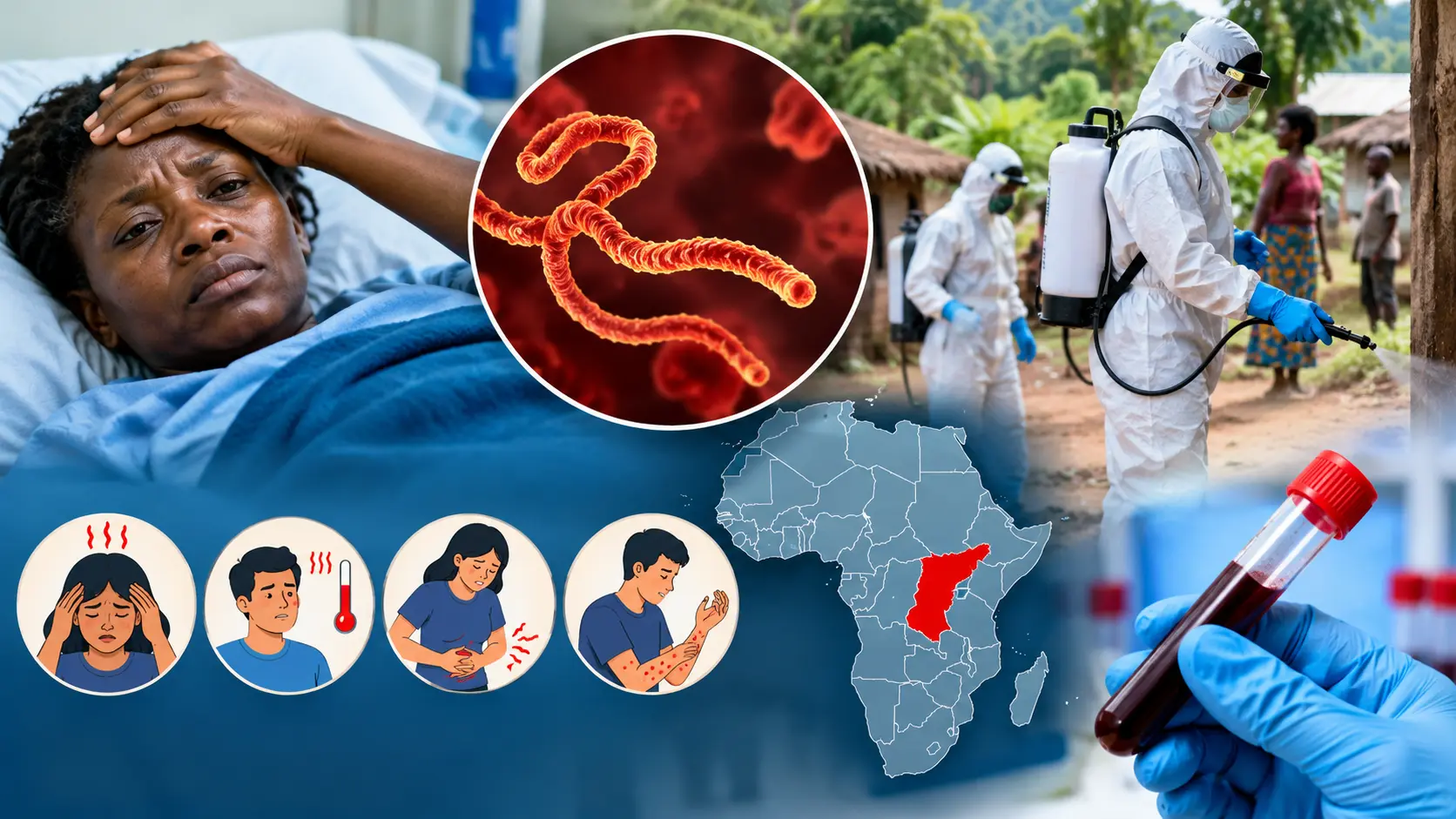
Quick answer: Bundibugyo Ebola virus is one of the six species of Ebola viruses. It is a dangerous disease that is often fatal. With a high risk of transmission, the infection causes severe body pain and fever that can quickly progress to internal and external bleeding and organ failure. The virus is contracted through direct contact with the infected person’s fluids and does not spread through the air. As of now, there has been a significant outbreak of the illness in the Democratic Republic of the Congo that started in May 2026 and has also reached Kenya and the Netherlands, with one person evacuated for medical care. There is currently no cure or vaccine for the infection.
What Is the Bundibugyo Ebola Virus?
Ebola is not a single virus, but a family of related viruses. Bundibugyo virus is one of the many rare types of the Ebola virus. This particular virus was first detected in 2007, when an outbreak occurred in the district of Bundibugyo, Uganda.
Compared to other, more common strains of Ebola such as the Zaire Ebola virus, Bundibugyo virus has been studied much less. This is problematic for the simple reason that the rapid diagnostic tests, vaccines, and treatments that have been developed for other strains of the disease are not effective against it. In fact, during the current outbreak, initial tests on blood samples taken from patients were negative, since the tests looked for signs of the Zaire Ebola virus and not Bundibugyo.
How Does Bundibugyo Ebola Virus Spread?
This is the part people worry about most, so let’s keep it simple.
Ebola is believed to start in fruit bats, which can carry the virus without getting sick themselves. People can catch it after contact with an infected animal, such as a bat or monkey, often through hunting or handling bushmeat.
Once a person is infected, the virus spreads from person to person through:
- Direct contact with blood, vomit, saliva, sweat or other body fluids of someone who is ill
- Touching surfaces, clothing or bedding that an infected person has contaminated
- Unsafe burial practices, where mourners touch the body of someone who has died from Ebola
- Poor infection control in hospitals and clinics, where healthcare workers are often among the hardest hit
Here’s the reassuring part: it does not spread through the air, through water, or casual contact like walking past someone in the street. A person also isn’t contagious until they start showing symptoms, so someone who feels fine isn’t spreading the virus, even if they’ve been exposed.
Quick answer: You cannot catch Bundibugyo Ebola virus by sitting near someone, sharing a bus seat, or breathing the same air. Close, direct contact with body fluids is what spreads it.
Symptoms of Bundibugyo Ebola Virus
Symptoms can appear anywhere from 2 to 21 days after infection. That’s a wide window, which is part of why contact tracing takes so long and is so difficult.
Early symptoms (easy to mistake for flu or malaria):
- Sudden fever
- Severe tiredness and weakness
- Muscle pain and headache
- Sore throat
Later symptoms, as the illness progresses:
- Vomiting and diarrhoea
- Stomach pain
- Rash
- Signs of kidney and liver trouble
- In some cases, unexplained bleeding or bruising
Because the early signs look so much like common illnesses, people in affected areas are often not diagnosed quickly. That delay is one of the biggest reasons the virus keeps spreading and why death rates stay so high.
The 2026 Outbreak: What’s Happening Right Now
This outbreak most probably started in February 2026, when the first spillover from animals to humans happened. It was only officially detected in mid-May 2026, when a series of unexplained deaths, including medical workers, in Ituri region of DRC occurred.
As of early October 2026, the World Health Organization (WHO) has recorded more than 8700 confirmed cases and over 4200 deaths in DRC, with a fatality rate of around 48%. It is the largest Ebola outbreak recorded in the DRC and one of the largest outbreaks in history globally.
The outbreak is now present in dozens of health zones in seven provinces, with Ituri and North Kivu being the most affected. It has spilled over into neighboring countries. In early October, Kenya reported its first-ever imported case of Ebola after a man traveled to Kenya from DRC through Uganda, sought medical attention, and eventually died in a hospital in Nairobi. A medical worker from Kenya was evacuated to the Netherlands after they tested positive for Ebola while caring for the sick.
WHO has declared the outbreak a Public Health Emergency of International Concern. However, no restrictions on travel or trade with the countries are recommended, and the risk to the population in the USA, UK, and other countries is still assessed as low.
Is There a Vaccine or Cure for Bundibugyo Ebola Virus?
Not yet, and that’s the hardest part of the current response. The Ervebo vaccine works well against Zaire Ebola virus but wasn’t designed for Bundibugyo virus and isn’t approved for it. Scientists are now trialling whether existing vaccines offer any protection and testing new treatments specifically for this strain.
What does work is early supportive care: fluids, oxygen, and treating symptoms and complications as they appear. Rapid diagnosis and early treatment meaningfully improve someone’s chances of survival.
Should People in the USA or UK Be Worried?
In short: No, not in the context of an outbreak that’s having a major impact on the population of the DRC. It’s a difference between a serious regional health emergency and a worldwide threat.
The WHO is classifying the risk within the DRC as very high, the risk to neighboring countries as high, and the risk to the rest of the world (including North America and Europe) as low. The few cases that have appeared outside of Central Africa, such as the one in Kenya, were rapidly contained and isolated. That’s precisely how containments of this kind are supposed to be handled, after all.
That being said, “low risk” is still a risk, particularly for people such as aid workers who find themselves in high-risk areas on a regular basis. If you’re planning on visiting any of the affected provinces in the DRC, make sure to check any official travel health advisories you can find online.
How to Protect Yourself and Others
- Avoid contact with bats, monkeys, or bushmeat in regions with active outbreaks
- Don’t touch the body of someone who has died from suspected Ebola
- If you’ve travelled to an affected area and develop a sudden fever, seek medical care immediately and tell the clinic about your travel history
- Healthcare workers should follow strict infection prevention protocols, including protective equipment and safe waste disposal
- Stay updated through official sources rather than social media rumours, especially during a fast-moving outbreak
Frequently Asked Questions
Is Bundibugyo Ebola virus the same as regular Ebola?
It’s a different strain within the same virus family. Zaire Ebola virus is the most well-known and the most studied, while Bundibugyo virus is rarer and has fewer existing tools built specifically for it.
How deadly is Bundibugyo Ebola virus?
Past outbreaks have had death rates between 30% and 50%. The current 2026 outbreak is tracking at around 48%, though this can shift as more cases are confirmed and treated.
Can Bundibugyo Ebola virus spread through the air?
No. It spreads through direct contact with infected body fluids, not through airborne transmission like a cold or flu.
Is there a vaccine for Bundibugyo Ebola virus?
Not an approved one yet. Researchers are testing whether the existing Zaire Ebola vaccine offers any cross-protection, alongside trials of new treatments.
Has Bundibugyo Ebola virus reached the USA or UK?
No confirmed cases have been reported in either country. A small number of cases and medical evacuations have occurred outside Central Africa, each one isolated and contained quickly.
Resources and Further Reading
- World Health Organization — Ebola disease caused by Bundibugyo virus: Disease Outbreak News, 8 October 2026 — https://www.who.int/emergencies/disease-outbreak-news/item/2026-DON619
- World Health Organization — Ebola disease fact sheet — https://www.who.int/news-room/fact-sheets/detail/ebola-disease
- CDC — Ebola Outbreak: Current Situation — https://www.cdc.gov/ebola/situation-summary/index.html