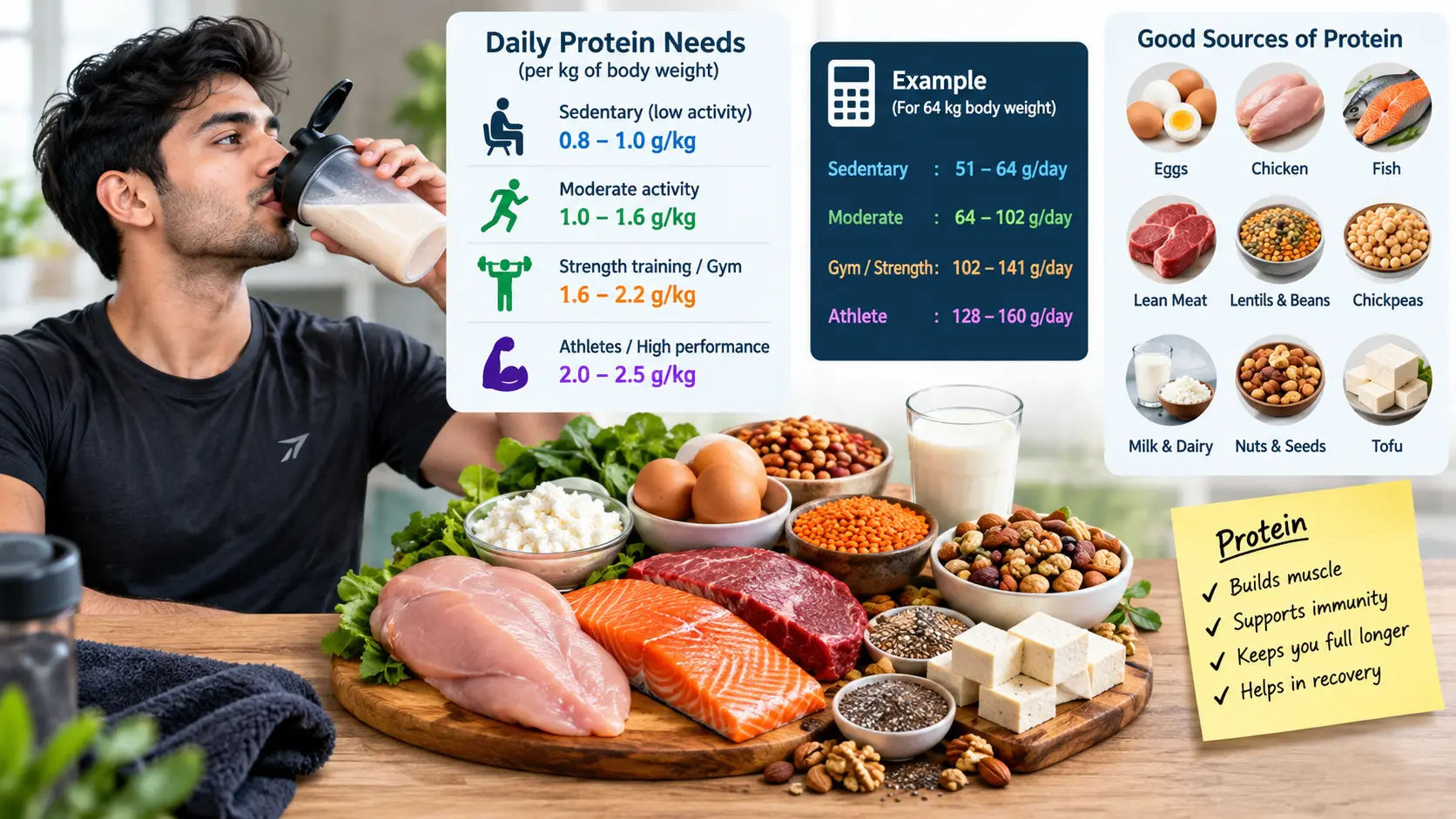
Most adults need at least 0.8 grams of protein per kilogram of body weight every day. That’s the bare minimum set by nutrition scientists to stop your body breaking down muscle. If you’re active, pregnant, or over 65, you likely need more — somewhere between 1.0 and 1.7 grams per kilogram.
If you are wondering how much protein do you need every day, the answer depends on your weight, activity level, and health goals. Most adults need at least 0.8 grams of protein per kilogram of body weight daily as a baseline, but active individuals, pregnant women, or older adults often require significantly more.
Quick Answer
- Sedentary adult: 0.8 g/kg body weight (roughly 56g for a 70kg person)
- Active adult: 1.2–1.7 g/kg body weight
- Older adult (65+): 1.0–1.2 g/kg body weight
- Pregnant or breastfeeding: add 25g on top of your normal amount
- Formula: weight in lbs ÷ 2.2 × your target g/kg number = daily grams
Why Protein Matters
Protein isn’t just for bodybuilders. Every cell in your body uses it — to repair muscle, make hormones, build antibodies, and keep your skin, hair, and nails growing properly. Skimp on it for long enough and you’ll notice: slower healing, weaker muscles, and a hunger that never quite goes away, since protein keeps you fuller for longer than carbs or fat.
How Much Protein Do You Need Every Day? (By Body Weight & Goals)
“The official number set by the National Institutes of Health is 0.8 grams per kilogram of body weight per day.”This has been determined using nitrogen balance studies and represents the minimum amount of protein needed to avoid muscle loss over time, in healthy adults. It should be noted that this is the minimum amount, not the optimal amount needed for feeling and performing your best.
Let’s look and see how these numbers play out, using you as an example. Let’s say you’re a 160lb male, looking to build some muscle (or just stay healthy). The calculation would go like this:
You must first convert lbs to kg: 160/2.2= 72.7kg. Multiply this number by the 0.8g/kg, which equals 58g/day.
This might be an acceptable amount of protein for a sedentary individual, but for someone active in the gym this is probably low. According to recent findings at the 2013 Protein Summit, meeting in Belgium (a gathering of the worlds top nutrition scientists), 1.0-1.2 g/kg for most is optimal for metabolic health, and 1.2-1.7 g/kg for active people and athletes is optimal.
Protein Needs by Activity Level
| Group | Grams per kg body weight | Example (70kg / 154lb adult) |
| Sedentary adult | 0.8 g/kg | 56g |
| Recreationally active | 1.0–1.2 g/kg | 70–84g |
| Strength training / athlete | 1.2–1.7 g/kg | 84–119g |
| Older adult (65+) | 1.0–1.2 g/kg | 70–84g |
| Pregnant / breastfeeding | +25g on top of baseline | varies |
Older adults are a special case. After age 65, your body becomes less efficient at using dietary protein to build muscle, a process researchers call anabolic resistance. That’s why geriatric nutrition guidelines now recommend 1.0–1.2 g/kg for healthy older adults, and up to 1.5 g/kg for those managing an illness or recovering from surgery.
What Happens If You Don’t Get Enough Protein?
Mild deficiencies are insidious. You may feel hungry sooner after a meal, notice that your hair is thinning, or that wounds are taking longer to heal before they close. After a few months or years of consistently insufficient protein intake, you could begin to experience loss of muscle mass (not necessarily reflected on a scale), decreases in immune function, and reduced recovery from illness or injury. Especially in older populations, diminished protein intake may even cause sarcopenia (loss of muscle mass) over just a matter of a few years.
Can You Eat Too Much Protein?
For most healthy people, no. There’s little if any evidence that higher protein diets (up to about 2 g/kg) are damaging to healthy kidneys, but if you have kidney disease, protein restriction is often recommended as part of treatment, so you should talk to your doctor before increasing your protein. And beyond a certain point, the body can’t use protein for energy, so it is stored as fat, so there’s a limit to how much protein you can eat and have it benefit you.
Best Ways to Hit Your Daily Protein Target
Spreading protein across your day works better than loading it all into one meal. Aim for roughly 25–30g per meal, three to four times a day, rather than a huge steak at dinner and almost nothing at breakfast.
Good everyday sources include:
- Eggs (6g per egg)
- Greek yoghurt (17g per 170g pot)
- Chicken breast (31g per 100g)
- Lentils (9g per 100g cooked)
- Cottage cheese (11g per 100g)
- Tofu (8g per 100g)
- Whey or plant protein powder (20–25g per scoop)
If you’re vegetarian or vegan, you can still hit your target — it just takes a bit more planning, since plant proteins like beans and lentils are often slightly lower quality per gram than animal sources. Mixing protein sources (rice and beans, for example) covers this gap easily.
The Bottom Line
0.8 g/kg is your floor, not your target. Most people feel and perform better closer to 1.0–1.5 g/kg, spread evenly across meals. Work out your own number using the formula above, then build your meals around it rather than guessing.
FAQ
How much protein should I eat in a day if I’m trying to lose weight?
Aim for 1.2–1.6 g/kg body weight. Higher protein intake preserves muscle while you’re in a calorie deficit and keeps you fuller, which makes the deficit easier to stick to.
Is 100g of protein a day enough?
It depends on your weight. For someone weighing 70kg (154lb), 100g works out to about 1.4 g/kg — plenty for general fitness, though athletes near the top of their weight range might need slightly more.
How much protein do I need to build muscle?
Most research points to 1.6–2.2 g/kg body weight for muscle growth, combined with resistance training. Going beyond 2.2 g/kg hasn’t been shown to speed up gains further.
Can I get enough protein from a vegetarian diet?
Yes. Combine beans, lentils, tofu, eggs, dairy, and whole grains throughout the day to cover both the quantity and the range of amino acids your body needs.
Does protein intake change as you get older?
Yes. Adults over 65 typically need 1.0–1.2 g/kg, higher than the general adult RDA, because the body becomes less efficient at using protein to maintain muscle with age.
Is too much protein bad for your kidneys?
Not for people with healthy kidneys. There’s no strong evidence linking high protein intake to kidney damage in people without pre-existing kidney disease. Those with kidney disease should follow their doctor’s specific guidance.